Roadblock Politics The Origins of Violence in Central Africa
Speakers
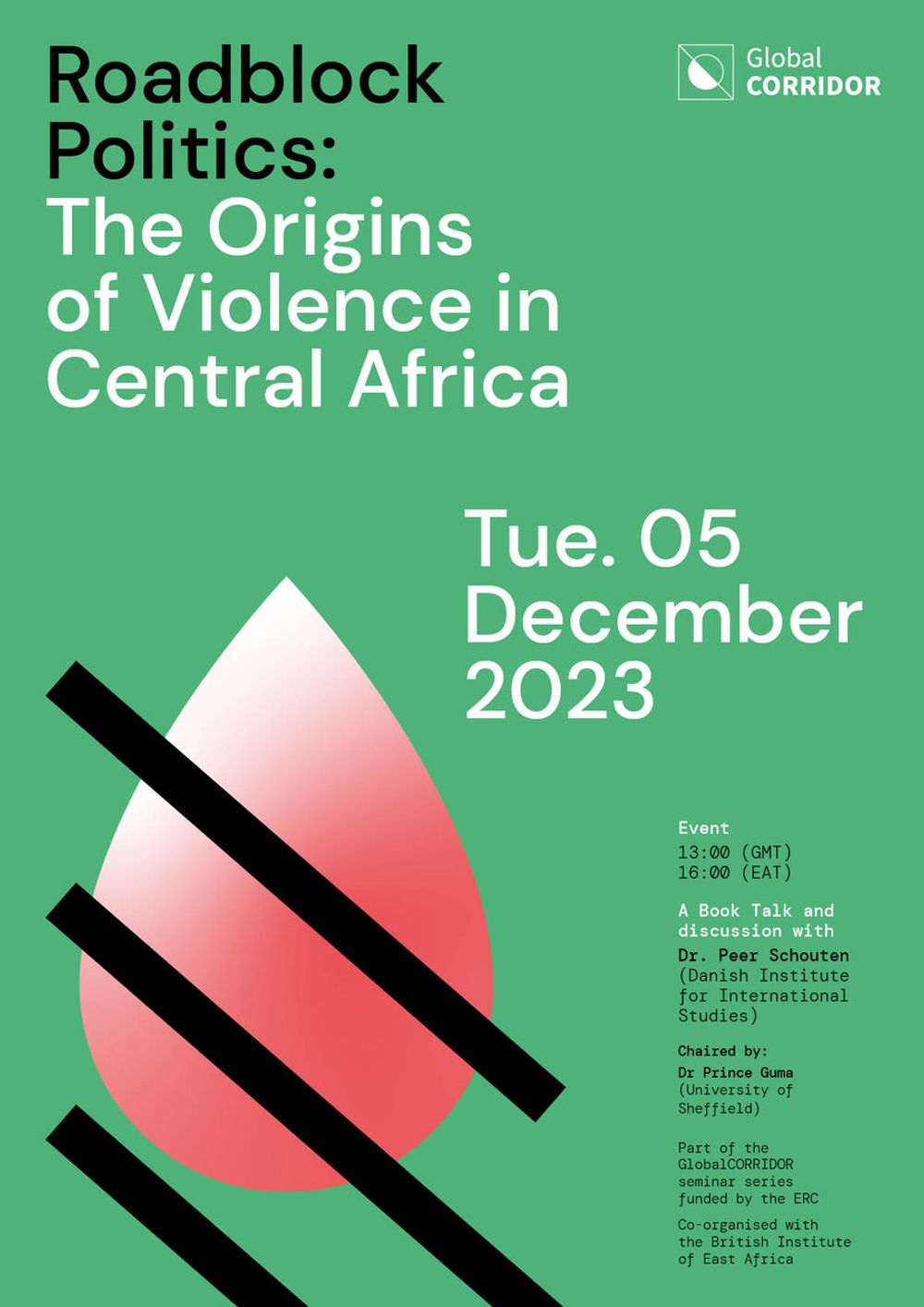
Peer Schouten’s Roadblock Politics: The Origins of Violence in Central Africa meticulously maps over a thousand of these roadblocks, demonstrating how communities, rebels, and state security forces derive resistance and power from their control over these narrow passageways. In doing so, he sheds light on the intricate relationship between roadblocks and what he terms "frictions of terrain" (p. 262), tracing the movements of multinational corporations and UN agencies through these checkpoints. These frictions vividly illustrate how rebels, locals, and state security forces interact in shaping or dismantling state authority and legitimacy. He introduces a fresh perspective for comprehending the forces behind state formation and conflict in the region, challenging conventional state theories and offering a new lens through which to understand the nature of statehood and local authority in Central Africa.
In his book talk, Schouten discussed his seminal work that challenges entrenched narratives; offering fresh perspectives on the nexus of state power, violence, and infrastructure. In his presentation, he drew from roadblocks/blockages and politics, power, and resistance; uncovering the intricate connections between these Central African roadblocks and the global supply chains, revealing how these roadblocks represent a unique form of power that thrives within the framework of supply chain capitalism. In the talk he offered a kind of paradigm-shift in examining the intricate interplay between state authority, violence, and infrastructure within the region.
Drawing from extensive fieldwork conducted in the Democratic Republic of Congo (DRC) and the Central African Republic (CAR), Schouten delved into the nuanced dynamics that underpin the region's logistical and trade networks; his empirical analysis unveiled the convoluted politics of control that have influenced the flow of goods and people over time.
Central to his thesis is the assertion that roadblocks and the regulation of crucial transportation routes serve as pivotal sources of power within the region. The talk elucidated how the contestation over these routes has acted as a catalyst for conflict, challenging prevailing narratives that often attribute conflict to control over vast territories or mineral-rich zones. By spotlighting the significance of controlling circulation and flow, Schouten disrupts the conventional understanding of power dynamics, which tends to prioritize territorial dominance.
Schouten challenged the prevailing conception of logistics as a uniform and frictionless global infrastructure. Instead, he underscored the messy and heterogeneous nature of logistical networks, necessitating a more nuanced understanding of their operation; the need to acknowledge the diverse realities of logistical practice, transcending simplistic narratives of seamless connectivity.
His insights extend beyond academic discourse, offering valuable contributions to broader debates surrounding conflict dynamics and power structures within the region. By interrogating conventional wisdom, Shoultern shed light on the multifaceted drivers of conflict, urging scholars and policymakers alike to reevaluate their analytical frameworks; emphasizing the messy politics of logistics underscores the profound impact of infrastructural governance on everyday life, highlighting the intricate ways in which power shapes lived experiences.
By unveiling the complexities of logistical control and its implications for conflict dynamics, Schouten's analysis enriches our understanding of the region's socio-political landscape, ultimately paving the way for more nuanced and informed approaches to governance and development.
You can find out more about the book here
And read a book review by Jonathan Silver here (link to website)