Karachi Report Launch and Film Screening
Speakers

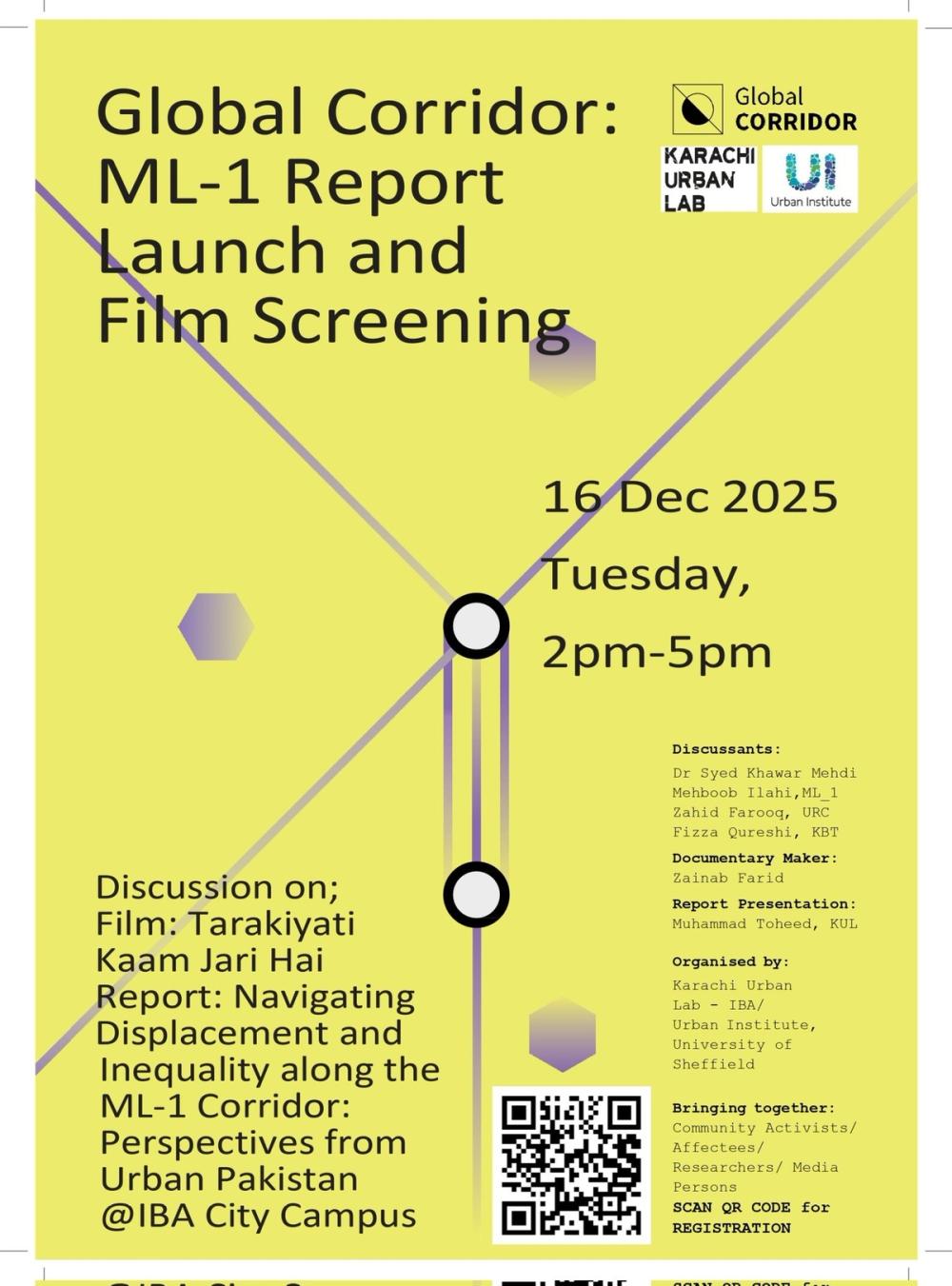
Organized to open a space for reflection and engagement, the session was moderated by Jawairiya Awan. A warm welcome from Muhammad Toheed, Director Karachi Urban Lab (KUL) IBA, who emphasized the importance of documenting community voices alongside technical narratives of large-scale development initiatives.
The short film Taraqiyati Kaam Jaari Hai captured the complexities of development in Karachi — illustrating how promises of connectivity and progress intersect with the realities of displacement, uncertainty, and community resilience. While many attendees acknowledged the transformative potential of mega projects like ML-1 for Pakistan’s economic future, the film poignantly raised the question: Development at what cost? Rather than opposing growth outright, community members featured in the film demanded dignified resettlement and meaningful participation in decision-making processes, rejecting displacement as an inevitable sacrifice for progress.
In the film Taraqiyati Kaam Jaari Hai, community members do not reject development or the transformation of Karachi’s infrastructure. They recognize the ML-1 project as part of a broader national imagination of progress and connectivity, framed as development for Pakistan. Yet the film insists on a more difficult question: development at what cost?
What unfolds is not opposition to infrastructure, but a demand for accountability. The costs of ML-1 are unevenly distributed, borne disproportionately by communities whose lives and homes are rendered precarious in the name of progress. Displacement is not viewed as an inevitable by-product of development, but as a political choice. The communities featured in the film articulate a clear claim—not against development itself, but for resettlement, dignity, and the right to remain within the city they have built and sustained.
Following the screening, Muhammad Toheed presented key findings from the newly launched report on the social and spatial impacts of the ML-1 project. The presentation highlighted patterns of housing loss, disrupted livelihoods, and insufficient resettlement planning — challenging official rationales that often sideline community well-being.
The findings were highlighting the severe human impacts anticipated along the ML-1 railway corridor, warning that Pakistan’s largest infrastructure project under CPEC continues to move forward without accounting for the thousands of families living beside the track. Presenting the report, Director Muhammad Toheed stressed that large-scale development in Pakistan often advances through a narrow focus on engineering and investment, sidelining the lived realities of communities whose homes and livelihoods lie directly within the project’s expansion zone. “Development that disregards people is not development,” he stated during the launch.
Using satellite imagery, GIS mapping, and field interviews, the research identified hundreds of housing structures in Karachi, Hyderabad, and Lahore that fall within the 25- and 40-foot clearance zones required for ML-1 construction and fencing. Residents expressed deep fears of eviction, citing a lack of clear information, contradictory official statements, and no resettlement plan. While many support national development, they reject displacement without compensation or relocation options. “These are long-established neighborhoods, not encroachments,” Toheed emphasized.
The report calls for transparent planning, meaningful community engagement, and a clear resettlement framework before construction begins. Without such measures, the ML-1 project risks intensifying urban inequality, dismantling social networks, and pushing vulnerable families deeper into precarity.
A panel discussion with experts then deepened the conversation. Dr. Syed Khawar Mehdi (CEO commonwealth), Zahid Farooq( Joint Director Urban Resource center karachi), Mehboob Ilahi( Chairman ML1 Mutassireen Action Committee), and Fizza Qureshi (Urban Planner and Researcher)each offered reflections, connecting the film’s narratives to broader urban justice themes. Their remarks underscored how infrastructure projects can produce uneven geographies of benefit and harm and called for frameworks that safeguard human rights in the face of rapid urban transformation.
Dr Syed Khawar Mehdi said that it is very sad that communities are not included in development projects, but rather the concept is becoming very clear that the bigger the project and the more money, the more corruption. To the extent that the impact of the project on the employment, life, education and health of the communities is not being paid attention to, while according to the Constitution of Pakistan, the state is responsible for food and shelter.
Zahid Farooq first thanked Karachi Urban Lab for organizing this session to highlight this public issue. He further said that his department, Urban Resource Center Karachi, has been with the railway victims since day one and the ML-1 Victims Action Committee is being supported in every way, be it providing a place for the committee meeting or participating in meetings with Pakistan Railways to present the victims' position and demand resettlement for these victims from the government.
Chairman ML-1 Mutual Action Committee Mehboob Elahi thanked Karachi Urban Lab and mentioned all the efforts of the people that he and the people of ML-1 Victims Action Committee have been requesting the government and Pakistan Railways for the past several years to conduct a survey of the victims and to tell the people how many feet of land the railways needs for the ML-1 project so that the government can arrange an alternative for the people whose houses are being affected by this project. He said that at present the lives of those living around the railway track are in fear and many people have become mentally ill. He said that he has written letters to various concerned ministers from the railways, but no one seems ready to resolve this issue. He added that we are not against the development of Pakistan and this project, but the problems and concerns of the community should also be understood.
Urban planner Fiza Qureshi, while explaining the poor planning, said that what are development projects for if communities are not being included? She said that the meaning of projects and development around the world is to facilitate communities and in fact, the concept of a development project without the participation of people is not good, while in Pakistan, decisions are made under a top-down approach, as a result of which most projects fail in implementation.
An open-floor session followed, with students, activists, local residents, and media personnel engaging in a robust question-and-answer period. Participants raised issues of policy transparency, inclusive planning, and the urgent need for systematic resettlement strategies for communities affected by ML-1 and similar initiatives.
Closing remarks were delivered by Dr Eram Ashraf (Honorary Appointment ,Department of International Relations and Politics, Swansea University, UK) who reiterated the need to align national development goals with equitable social outcomes, urging stakeholders to build bridges between technical expertise and community aspirations. She further said that her work is on the relations between Pakistan and China and she has a PhD in that field. She added that the session on fire was very informative because it revealed many facts that are not visible in international data or policy. It is extremely important that those who are directly affected by any project and their losses are included in the project and they are compensated for their losses under the same project.
The event concluded with refreshments and networking, fostering further exchange among attendees committed to socially grounded infrastructure narratives.